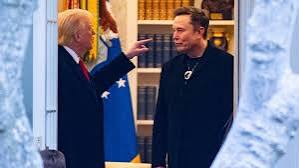
Introduction
The relationship between political leaders and business magnates has always been complex, often characterised by mutual dependence and occasional strife. In recent years, the fallout between President Donald Trump and billionaire entrepreneur Elon Musk has illuminated the potential ramifications of such discord, not only for American markets but also for the global economy. This article explores the nuances of their relationship, the factors leading to their estrangement, and the broader economic implications, particularly in the context of the trade wars instigated by the Trump administration.
Background on Trump and Musk’s Relationship
Initially, in 2019 Trump and Musk shared a cordial relationship. Musk was an early supporter of Trump’s initiatives, particularly in the realm of innovation and manufacturing. The President even appointed Musk to his advisory councils, which aimed to harness the power of the private sector to solve some of the nation’s most pressing issues. However, as the Trump administration progressed, the relationship began to sour, leading to public disagreements and a notable rift. “I feel a bit stronger that he is not the right guy,” Musk said of Trump at the time. “He doesn’t seem to have the sort of character that reflects well on the United States.”
“I don’t think this is the finest moment in our democracy,” Musk added when Trump beat Hilary Clinton to become the 45th POTUS.
The Breaking Point
The discord escalated during the COVID-19 pandemic, when Musk openly criticized the government’s lockdown measures, calling them “fascist.” His outspoken nature clashed with Trump’s narrative, leading to a divergence in their approaches to governance and business. Moreover, Musk’s decision to move Tesla’s headquarters to Texas, a state that had adopted a more lenient stance on pandemic restrictions, further strained their ties. The culmination of these tensions was marked by Musk’s withdrawal from Trump’s advisory councils, signaling a clear break in their once-cooperative dynamic. This was in the previous Trump Administration, roll on to the present Trump Administration and Trump appointed Musk to lead the Department of Government Efficiency, or DOGE, which was tasked with cutting federal government spending, but fell far short of Musk’s $1 trillion goal.
Musk quickly became a member of Trump’s inner circle, participating in Cabinet meetings and traveling on Air Force One with his young son. Less than a month into his government service, Musk professed on X: “I love @realDonaldTrump as much as a straight man can love another man. The tech billionaire formally endorsed Trump on July 13, 2024, moments after Trump survived an assassination attempt at a campaign rally in Butler, Pennsylvania.
“I fully endorse President Trump and hope for his rapid recovery,” Musk wrote alongside video of the ‘bloodied’ presidential candidate raising his fist in the air as he was surrounded by Secret Service agents. Musk contributed over $277m to endorse Trump which no doubt assisted the election of Trump.
Roll on to the end of the first 100 days and In the following days, Musk escalated his criticism of the legislation Trump has dubbed a “big, beautiful bill,” calling it a “disgusting abomination” in a lengthy early June tirade on his social media platform. The insults continued through the week, reaching a climax on June 5 with Trump threatening to cancel Musk’s lucrative government contracts and Musk claiming that Trump could not have won the presidency without him.
Economic Implications of the Fallout
The fallout between two such influential figures inevitably has ramifications for the economy.
- Market Volatility: The relationship between government policy and corporate performance is a delicate one. Musk’s ventures, especially Tesla and SpaceX, are highly sensitive to regulatory environments and government incentives. A breakdown in communication between Musk and the Trump administration could result in uncertainty that may destabilise stock prices and investor confidence. This volatility can extend beyond the U.S. borders, affecting global markets that have vested interests in Musk’s companies.
- Innovation and Investment: Musk is a key player in several industries, including electric vehicles, renewable energy, and space exploration. His ventures are significant beneficiaries of federal support and subsidies. A deteriorating relationship with the president could lead to shifting priorities in government funding and investment strategies, potentially stifling innovation. This could hinder the transition to a greener economy, which is crucial for meeting global climate goals.
- Trade Wars and Supply Chains: The ongoing trade war initiated by the Trump administration has already disrupted global supply chains, particularly in the technology and automotive sectors. Musk’s companies, reliant on international supply networks, could face increased costs and delays due to tariffs and trade restrictions. This situation may necessitate a reevaluation of supply chain strategies, compelling companies to seek alternative suppliers or invest in domestic production, which could further impact economic growth.
- Foreign Relations: The fallout between Trump and Musk reflects a broader narrative of shifting alliances within American capitalism. For instance, Musk’s ventures in China, particularly Tesla’s Gigafactory in Shanghai, may be jeopardised by escalating tensions between the U.S. and China. A fractious relationship between two of the world’s most powerful individuals could exacerbate these tensions, influencing trade policies and international relations across various sectors.
Finally
The fallout between President Donald Trump and Elon Musk serves as a poignant reminder of the intricate relationship between politics and business. As their estrangement unfolds, the implications for the global economy and ongoing trade wars are significant. Market volatility, innovation stagnation, disrupted supply chains, and strained foreign relations are all potential outcomes of this rift. As the economic landscape continues to evolve, the interplay between influential leaders and industry visionaries will remain a crucial factor in shaping the future of both the American and global economies.
In navigating these complexities, it is imperative for policymakers and business leaders alike to foster cooperative relationships that prioritise innovation, stability, and sustainable growth in an increasingly interconnected world. As we move forward, the lessons drawn from the Trump-Musk fallout will undoubtedly inform the dynamics of power and influence in the economic arena for years to come. But this writer feels the damage to the World’s economy is already done and will take years for any administration in the US to be trusted as a beacon of hope and trade, as it falls into the abyss of corruption and onslaught brought on by no other individual than Donald J. Trump.
 Killeigh Media